
Every gram accounted for, in writing
In Iceland the sale of eiderdown is protected by law: down may not be sold unless it has been inspected and certified by a licensed assessor. Goose down carries a separate set of standards covering animal welfare, traceability and chemical safety, and bed linen is governed by fiber, chemical and mill standards of its own. This page sets out every certificate that applies to the materials we work with, and what each one actually tests. Only eiderdown is certified article by article; the rest are material and supply-chain standards.

Íslenskur Æðardúnn · Icelandic Eiderdown
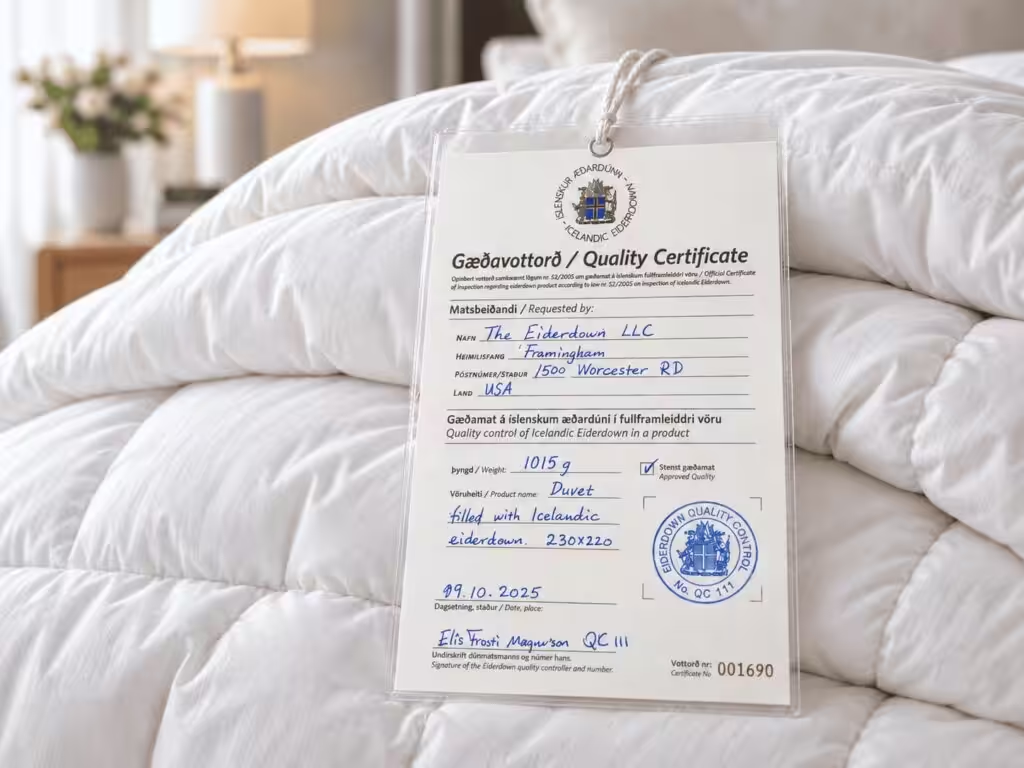
The certificate confirms that the down in your product has been inspected, tested and approved by the Icelandic Eiderdown Quality Committee under law no. 52/2005. Only fully approved batches may carry the seal, and only a licensed assessor may issue it.
100% purity
The assessor confirms that the down is professionally cleaned and free of feathers, grass and other impurities. Only the cleanest down receives the highest rating.
Quality and cohesion
The certification ensures the down has the correct cling. Cohesion is the characteristic that gives eiderdown its insulation and lightness, and it cannot be reproduced in any other down.
Correct weight
The assessor weighs the down to precision and seals the product, so the buyer receives exactly the amount paid for.
Guarantee of origin
The certificate is your security that this is genuine Icelandic eiderdown, gathered by hand from abandoned nests in wild nature and processed within Iceland.
Signed, numbered, traceable
Each product includes an official Icelandic Eiderdown Quality Certificate, signed and numbered against its batch. Quote the number and we can name the year, the colony and the assessor.
Wild-sourced down crosses borders on paperwork
Eider is a protected wild species. Down gathered from its nests may only be exported and imported under permit, and every shipment we send carries the relevant authorisation.
Migratory Bird Permit Memorandum
Every order is fully authorized by the U.S. Department of the Interior for legal personal import of eiderdown into the United States. The memorandum is published in full and travels with the shipment.
Export documentation
Wild-sourced material leaves Iceland with the export paperwork its destination requires, referenced against the shipment. Tell us the country and we will confirm what is issued before you order.
Harvest license
Down is gathered only from abandoned nests after the ducklings have left, under license from the Icelandic Ministry of Food, Agriculture and Fisheries. No bird is handled, and none is plucked.
Cleaned, graded and weighed before anything is sealed
Quality control on eiderdown is mostly subtraction. Raw down arrives from the nests full of seaweed, grass, shell and feather, and every stage that follows is about taking that out without damaging the clusters that make the down worth having.
Cleaning
Down is dried, tumbled over a heated grid to shake the coarse matter loose, washed in soft water without detergent, then dried again in slow heat.
Hand sorting
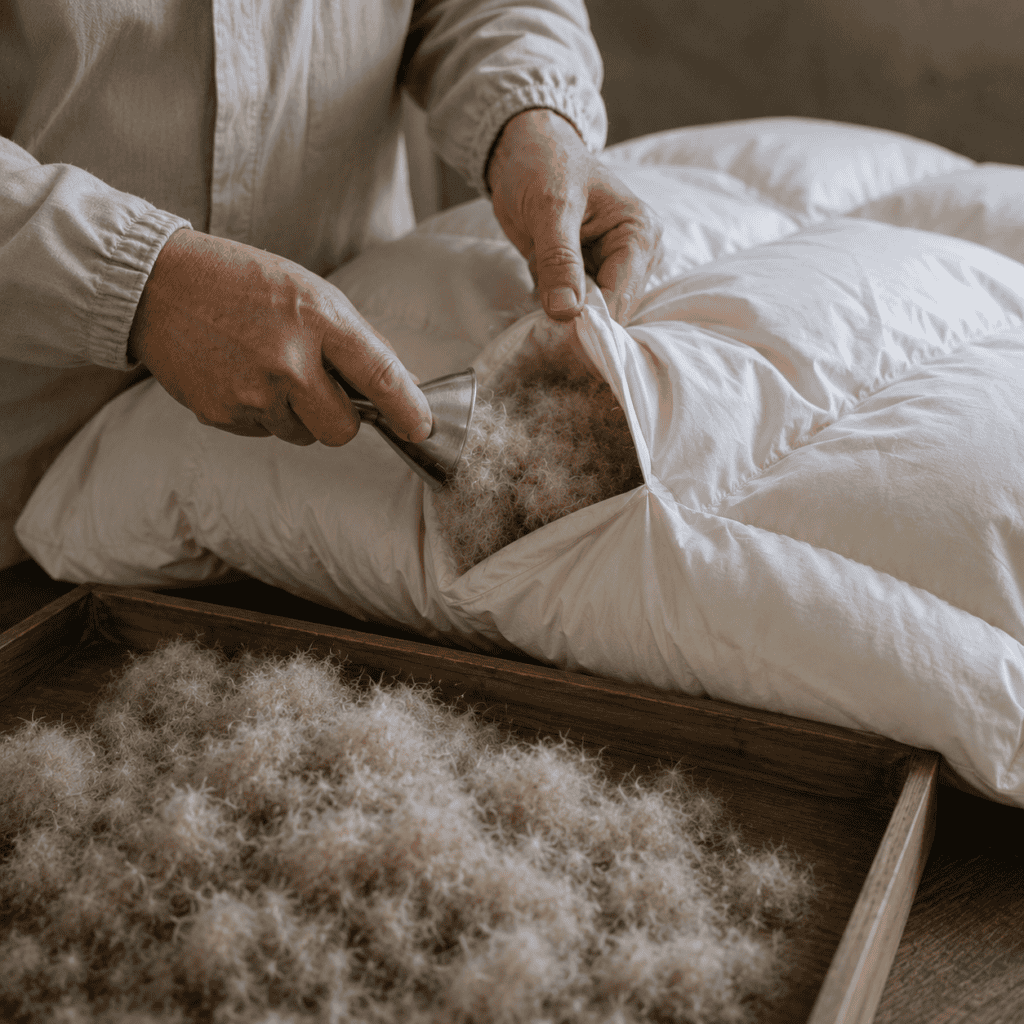
The last stage is done by hand at a lit table, where remaining stalks and quills are picked out one at a time. A kilogram of raw down takes roughly forty hours and comes out at about 600 to 700 grams.
Fill weight
Cleaned down is graded and weighed into each article to a stated fill weight, and the finished article is weighed again before it is closed.
Inspection and seal
A licensed government assessor weighs, inspects and seals every finished article. In Iceland that inspection is a condition of sale rather than a courtesy.
Cleared for personal import into the United States
The U.S. Fish and Wildlife Service addressed eiderdown directly in Migratory Bird Permit Memorandum MBPM-10, issued on 29 October 2021. It confirms that bringing eiderdown into the United States for your own use is authorized without a permit.
The common eider is unusual among birds protected by the Migratory Bird Treaty Act: the hen sheds her own breast down while nesting, so nothing is taken from a living bird. On that basis the Service reads "lawfully taken" to include down collected from eider nests, provided it is lawfully and sustainably collected, processed and sold under the laws of the country it came from.
Anyone who legally buys eiderdown abroad may import it for their own personal use without an MBTA permit. That covers finished articles where the down is doing the insulating — comforters, pillows and similar — and it covers online orders shipped to you.
The memorandum asks that you keep documentation showing the down was lawfully and sustainably collected; a government-issued harvesting permit is the example it gives. The numbered certificate sealed into every article we ship is that documentation.
Farmed down needs a different kind of proof
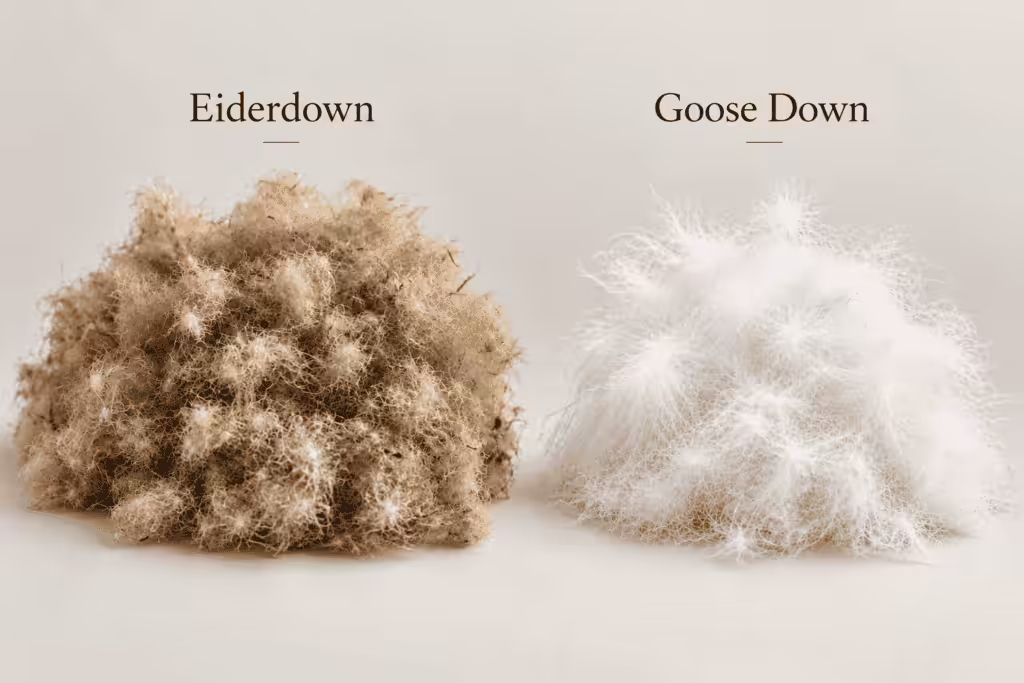
Eiderdown is gathered from wild nests, so its certification is about purity and origin. Goose down comes from farmed birds, so the questions change: how were the birds kept, was anything plucked from a live animal, and can the supply chain be followed backwards from the finished product to the farm.
Responsible Down Standard
Welfare · traceabilityProhibits live-plucking and force-feeding, and requires that welfare is respected from hatching to slaughter. Certified down is tracked through every stage of the supply chain, so the finished product can be traced back to a certified farm.
Downpass 2017
Welfare · verificationA European standard covering the same welfare prohibitions, with unannounced audits of farms and collection points and laboratory verification that the fill in the finished product matches the declaration on the label.
OEKO-TEX Standard 100
Chemical safetyTests fill, shell fabric, thread and labels against limits for restricted substances, including residues from cleaning and finishing. Certification covers the article as a whole rather than one component.
NOMITE
Suitability for allergy sufferersConfirms that a down or feather article uses a shell dense enough to be unsuitable for dust mites, so the product can be recommended to house-dust-mite allergy sufferers.
Standards that apply to sheets, cases and covers
Cotton and flax are agricultural crops turned into cloth across several mills. The standards below cover where the fiber was grown, what was used to spin, weave and finish it, and what remains in the fabric when it reaches you.
Global Organic Textile Standard
Covers organic fiber content, the chemical inputs permitted at every stage from ginning to finishing, and social criteria at each site. Certification follows the cloth through spinning, weaving, dyeing and making up, so the whole chain is audited rather than the crop alone.
OEKO-TEX Standard 100
Tests the finished fabric together with its thread, buttons and labels against limit values for substances including formaldehyde, azo dyes, pesticide residues and heavy metals. Limits are stricter for articles held against the skin, which is the class bed linen falls into.
OEKO-TEX Made in Green
Combines restricted-substance testing with an audit of the mill itself: environmental performance and working conditions. Each certified article carries an ID that resolves to the countries and facilities where it was produced.
European Flax
Certifies flax grown in Western Europe without irrigation, defoliation or genetic modification, traced back to the field. Flax retted in the field rather than in tanks is what gives linen its dry handle and long life.
Masters of Linen
A stricter mark than European Flax: the fiber must be grown in Europe and also spun and woven there. It records where the cloth was actually made, not only where the crop was raised.
Fairtrade Cotton
Sets a minimum price and a premium paid to cotton farmer organisations, prohibits forced and child labor, and restricts hazardous agrochemicals. It certifies the terms under which the raw cotton was bought rather than the fabric itself.
The certificates themselves, as issued
The marks above are the standards. These are the individual certificates held against them by the mills and makers whose cloth we buy, reproduced exactly as issued. Each one names its holder, the laboratory that issued it and the dates it runs between, so you can check it rather than take our word for it.
OEKO-TEX Standard 100
Issued by Centexbel in Belgium against test report 2558. It covers knitted and woven fabrics in 100% cotton, cotton/spandex, 100% linen, cotton/linen and viscose rayon, dyed and printed, tested to Product Class I — the baby-article class, which is the strictest of the four.
OEKO-TEX Standard 100
Issued by Hohenstein Laboratories in Germany against test report 24.1166726. It covers duvet covers, bed sets, quilts, pillows and blankets made from recycled polyester and its blends, with at least 20% post-consumer PET content, also to Product Class I.
What is measured, and by whom
Seals cover process. These tests cover the material itself, batch by batch, and the reports are available on request. Standard references marked to confirm are pending our laboratory's sign-off.
Which certificate applies to which fill
What arrives with your product
Certificates are not marketing inserts. Keep them: warranty claims, resale and insurance valuations all reference the certificate number.
Asked about certification
If you need a specific report for customs, insurance or a specification sheet, ask and we will send the original PDF.
Request documentsIs eiderdown legal to buy and import?+
Yes, when it is certified and documented. Iceland permits sale only of inspected and certified down, and import into the United States is covered by a Migratory Bird Permit Memorandum from the Department of the Interior. For other destinations, ask us and we will confirm the paperwork that applies before you order.
Are the birds harmed?+
No. Eiderdown is gathered by hand from nests the ducks have already left, which is why it is cruelty-free by method rather than by audit. For goose down, the Responsible Down Standard and Downpass exist precisely to rule out live-plucking and force-feeding, and we buy only against those certificates.
What is the difference between RDS and Downpass?+
Both certify animal welfare and chain of custody, and both prohibit live-plucking and force-feeding. RDS is administered by Textile Exchange and is the more widely recognized mark internationally; Downpass is European in origin and adds unannounced farm audits together with laboratory verification of the finished fill.
Does a certificate guarantee fill power?+
Welfare certificates do not. Fill power and species composition are measured separately in an accredited laboratory, and those figures appear on the product page rather than on the welfare seal.
Can I verify my own certificate?+
Yes. Send us the number printed on the certificate and we will confirm the harvest year, colony, sealed weight and assessor from the batch record, whether you bought the piece from us or second-hand.